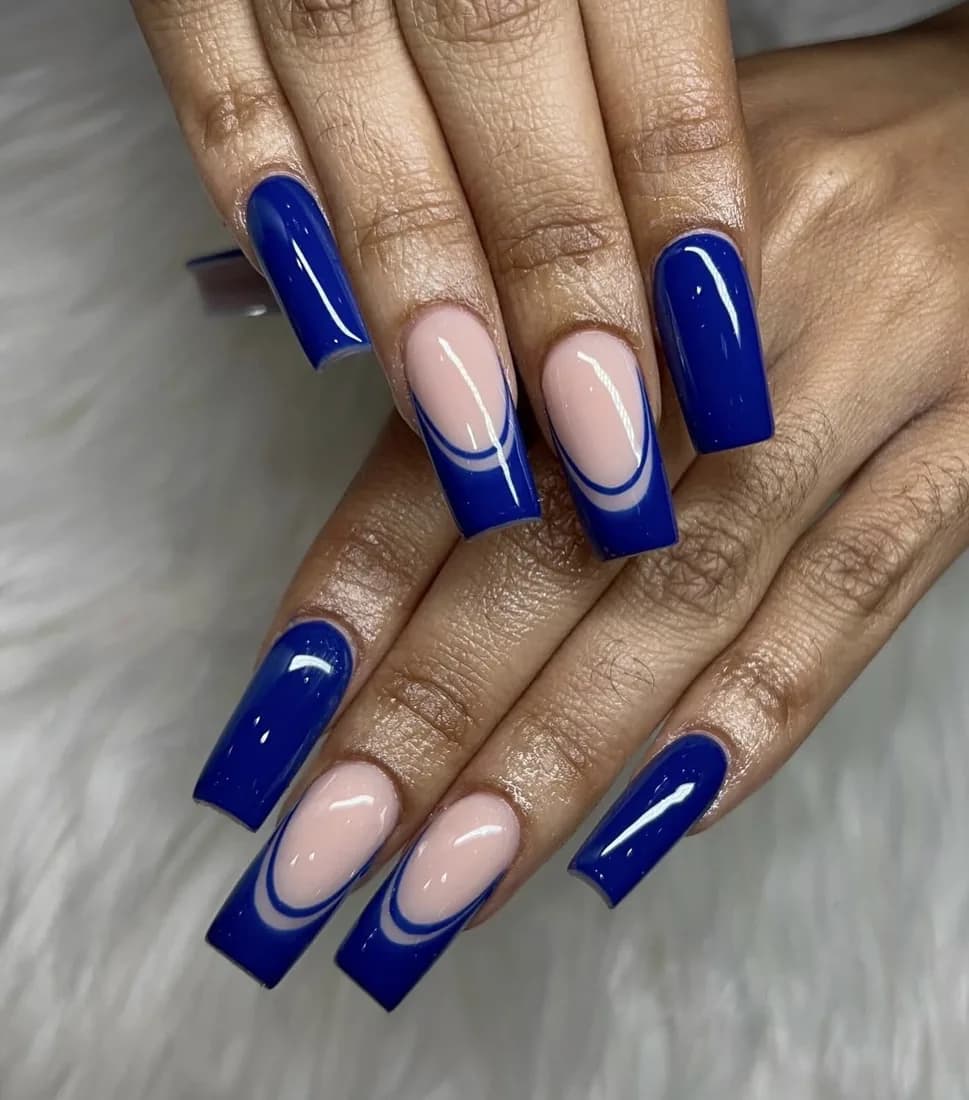
 Cobalt French · square · from our gallery
In this post
We get asked some version of this most days: which one should I get, and which one is least damaging? This is the answer we would give you in the chair with ten minutes and a pen. Nothing here is a ranking; the point is to put every system side by side, with our real prices and wear times, so you can pick rather than be sold.
What each one actually is
Gel polish is color that stays liquid until it is cured under a lamp. It adds no length and very little thickness; it is a finish, not a structure.
Dip powder is color built by dipping the nail into fine pigment over a bonding liquid, then sealing it. No lamp. The Cleveland Clinic describes dip manicures as sturdier and more durable than other types, especially if you work with your hands a lot.
Acrylic is liquid monomer and powder, mixed into a bead and sculpted by hand over a tip or form. It hardens in the air without a lamp. It is the most durable enhancement we offer and the best choice for real length.
Builder gel is a thicker gel sculpted over your own nail and cured into shape. It is more flexible than acrylic and near-odorless while it goes on. It reinforces the point where nails usually bend and break; strength first, length second.
Gel X and Tap Gel are soft-gel full-cover tips: gel goes inside the tip, the tip is pressed on, and the nail is cured under the lamp. The natural nail is not filed down, the set is lighter than acrylic, and it soaks off cleanly.
The decision table
Everything below comes from our menu. Wear times are typical on a healthy nail; your habits move them in both directions.
- Classic manicure — lacquer, no lamp, 5–7 days, $25.
- Gel manicure — gel polish, lamp, touch-dry when you stand up, 2–3 weeks, $40. Removal: soak off, $5 with a service.
- Dip powder — pigment and sealer, no lamp, 3–4 weeks, from $45. Removal: dip take-off, from $10.
- Acrylic — liquid and powder sculpted by hand, no lamp unless you choose a gel finish, fill every 2–3 weeks, basic full set from $47, fill from $40. Removal: soak off, $5 with a service.
- Builder gel — sculpted gel over your own nail, lamp, fill every 2–3 weeks, full set from $55, fill from $50.
- Gel X — soft-gel tips bonded and cured, lamp, 3–4 weeks, full set from $55, fill from $50. Removal: Gel X take-off, from $15.
- Tap Gel — soft-gel tips bonded and cured, lamp, wears in the same range as Gel X, full set from $55, fill from $50. Removal: Tap Gel take-off, from $20.
Lamp or no lamp
We have a separate post on whether UV nail lamps are safe. The short version: gel polish, builder gel, Gel X and Tap Gel all need the lamp, because gel only hardens under light. Dip powder does not. Acrylic does not, as long as you finish it in regular lacquer; choose the gel finish and the color coat is cured.
The American Academy of Dermatology suggests SPF 30 broad-spectrum sunscreen on your hands before a gel service, or gloves with the fingertips snipped off. If you would rather skip the lamp, dip and lacquer-finished acrylic are the long-wear options that let you.
Where the damage really comes from
The honest answer to which product is least damaging is that the product is mostly not the problem. The AAD puts it plainly: to get acrylic to stick, the surface of the natural nail must be filed until it feels rough. The same page says removal usually means soaking in acetone or filing the nails off, and that frequent touch-ups can seriously damage your natural nails.
On dip, the AAD says most people can wear it without a problem, and also that the acetone used to remove it peels off layers of nail and thins it over time. The Cleveland Clinic adds that the buffing and filing done so dip adheres may weaken the nail.
So the questions that protect your nails are about technique, not brand: light prep or aggressive filing, soaked off or pried, cuticles left alone. The AAD says never to let your manicurist push or cut your cuticle, because that is how inflammation and infection start.
The honest downsides of each
Gel polish chips. Less than lacquer, but it does, especially if you use your nails as tools. It is also the one most people peel off in the car, which the AAD asks you not to do; if an edge lifts, book a soak-off.
Dip has a hygiene catch: both the AAD and the Cleveland Clinic flag fingers dipped into a jar other people have dipped into. The Cleveland Clinic's fix is to ask for the powder to be sprinkled onto the nail instead, and you can ask any salon how they do it. Our gel versus dip health comparison goes further into infection, allergy and removal.
Acrylic is the most durable, and also the one that needs the most filing and a fill every two to three weeks. The AAD's warning about frequent touch-ups applies most here, which is why we mean it when we say take a break sometimes.
Builder gel and Gel X are gentler on prep and come off more cleanly, but they still involve a lamp and a soak to remove, and a pried-up edge will lift.
A picker, by how you use your hands
- You wash your hands forty times a shift: short length, and either dip for the wear or gel polish for the easiest removal.
- You type all day: gel polish or builder gel at a short-to-medium length.
- You garden, lift, or work with tools: acrylic for strength, or dip if you want no lamp. Keep the shape rounded; a squarer edge catches.
- You have one event and then want your own nails back: gel polish, which soaks off for $5 with a service, or Gel X if you want length for the weekend.
- Your nails are already thin or peeling: the AAD says covering up brittle, soft or damaged nails can worsen the problem. A classic manicure and a few weeks off is the better advice.
When to see someone who is not us
We are licensed nail technicians, not medical providers. A nail lifting from the bed, discolored or thickened, or skin around it that is red and sore, is a dermatologist's question, not ours. The AAD says to see a board-certified dermatologist if a nail problem is still there four weeks on. We cannot treat fungus or work over anything open, and we will tell you plainly when that is what we see.
When you book or walk in, tell us what you do with your hands and how long you want the set to last. Ask for gel polish, dip, acrylic, builder gel or Gel X by name, or describe your week and let us suggest one. Your total is agreed before we start.
Questions we get
Which nail service is least damaging?
Dermatologists point to rough filing and removal, not the product itself. Any system with light prep, soaked off rather than pried, is easier on your nails than the same system done roughly. Gel X does not file down the natural nail; a classic manicure needs no filing at all.
Dip powder vs gel: which lasts longer?
On our menu, gel polish wears 2–3 weeks and dip 3–4 weeks. Dip is the sturdier of the two; gel is thinner and the cheaper of the two to remove, $5 with a service against a dip take-off from $10.
Is Gel X better than acrylic?
Different, not better. Acrylic is the most durable and the one for real length; Gel X is lighter, needs no filing down of the natural nail, and soaks off cleanly. A basic acrylic full set starts at $47+, Gel X at $55+.
What does removal cost at Sora?
Soak off is $5 with a service or from $10 on its own. Dip take-off is from $10, Gel X take-off from $15, Tap Gel take-off from $20. Everything is soaked, never pried.

Written by the team at Sora Nail Bar, 4294 US Highway 98 North, Lakeland. We are licensed nail technicians, not medical providers — when something needs a dermatologist or podiatrist, we say so. About us.
Sources
- Dip powder manicure: How to avoid infection and other problems — American Academy of Dermatology
- Artificial nails: Dermatologists' tips for reducing nail damage — American Academy of Dermatology
- Gel manicures: Tips for healthy nails — American Academy of Dermatology
- Dip Powder Nails: Pros and Cons — Cleveland Clinic
Ready to book? See Manicures · Dip Powder · Acrylic & Extensions · Gel X & Tap Gel, or the full menu.
Keep reading
Services explained8 min read
Builder Gel, Gel X and Tap Gel: Which One Are You Asking For?
Three gel systems, one price, different jobs. What builder gel (BIAB), Gel X and Tap Gel each do, who they suit, how they come off and why tips lift.
· The Sora team
Nail care8 min read
Gel vs Dip Nails: Which Is Better for Your Health?
Gel vs dip nails for your health: the UV lamp, the shared powder jar, allergies and acetone removal, with what dermatologists advise and when to see one.
· The Sora team
Services explained7 min read
Why Your Gel Nails Lift After Three Days
Five technician-side reasons gel lifts at the cuticle, three client-side ones, what to say at your next appointment, and how Sora's 7-day repair applies.
· The Sora team