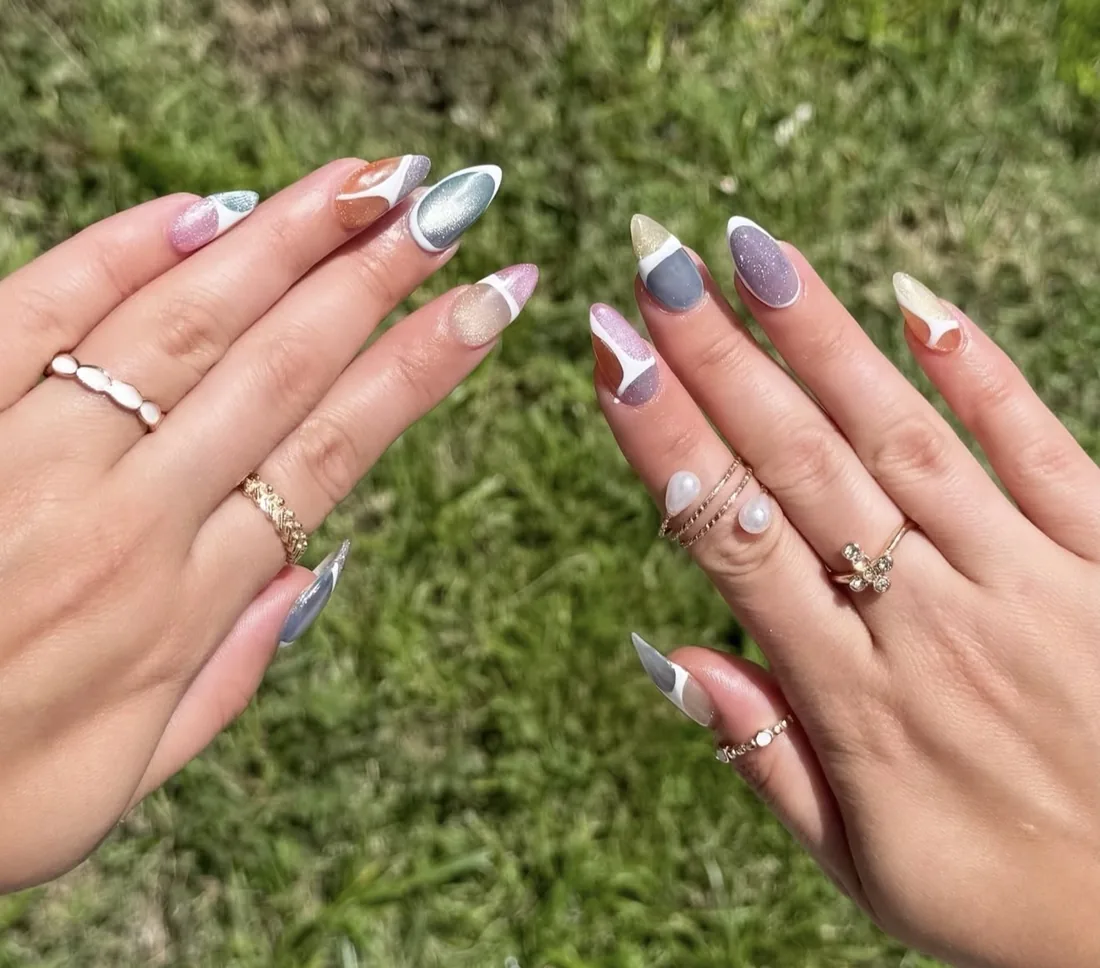
 Pastel multi-color · from our gallery
In this post
People ask us why a gel manicure that lasted three weeks somewhere else lasts ten days here. Usually the answer is not the gel. It is what happens to the hands in between, and in Lakeland that means a lot of water, a fair amount of chlorine, and heat for most of the year. We went and found the actual numbers.
What is in Lakeland's water
Lakeland Water Utilities draws from its own wells in the Floridan aquifer and publishes finished-water figures for both plants. For 2023, total hardness was 108 mg/L at the Combee plant and 126 mg/L at the Williams plant. Free chlorine residual was 2.3 mg/L and 2.7 mg/L respectively. pH sat just over or just under 8.
The USGS classes 61 to 120 mg/L as moderately hard and 121 to 180 mg/L as hard. So depending on which plant feeds your street, your tap water is moderately hard or hard. The USGS also notes that in hard water, soap reacts with calcium to form soap scum, the film you see on a shower door. Our guess, and it is only that, is that a thin version of the same film is part of why a gel top coat looks dull after a week of hand-washing.
Why water matters more than the coating
A cured gel coating is not very bothered by tap water. The nail plate underneath is. The American Academy of Dermatology puts it plainly in its healthy nail tips: too much water exposure can weaken your nails, causing them to split, peel, or break. Their advice is to wear gloves when cleaning or washing dishes and to moisturize after hand washing.
What we see in the chair is that chips start at the tip and lifting starts at the cuticle, and both show up sooner on hands that are wet all day. The bond at the edges is what gives up first. A StatPearls review on fungal nail infection makes a related point, noting that repeated exposure to water in wet work compromises fingernails, and it suggests gloves for people who wash dishes for a living.
Brittle nails are not rare. A 2005 review in the Journal of the American Academy of Dermatology estimated that brittle nails affect about 20% of the population, with women affected twice as often as men. If yours peel in layers, the fix is mostly in the sink, not the salon.
Pools, chlorine and heat
The chlorine in your tap water is there to keep it safe, and at 2.3 to 2.7 mg/L it is not going to strip a manicure. A pool is a different dose for a different length of time, and the water is warm. We do not have a number for your pool, but we can tell you what we see in August: dulled top coats, lifting at the cuticle, and dip that looks chalky at the free edge. The honest fix is to rinse your hands in fresh water when you get out and put oil on the cuticle area once they are dry.
Heat matters for a simpler reason. Hands sweat, sweat is water, and a day outside keeps the hands damp for longer. Gel does fine with heat on its own. It is the heat plus constant damp that shortens the wear.
The routine, in five lines
- Gloves for dishes and cleaning. The AAD's advice, and the single biggest change most people can make.
- Rinse and oil after swimming. Fresh water off, dry, then oil on the cuticle and under the free edge.
- Sunscreen on your hands. The AAD recommends a broad-spectrum, water-resistant SPF 30 or higher on the hands before a gel manicure. Here is why dermatologists advise it for nail lamps. We would say it is good sense all summer.
- Keep the free edge capped. If you file at home, file gently and do not file through the top coat at the tip; that is the seal that keeps water out.
- Never pick or peel. The AAD is blunt about this: when the color starts to come off, don't pick at it. Book a removal instead.
Why soak-off removal matters more for wet hands
If your nails are never fully dry, they are already a little softer than the textbook version. Peeling gel off at home takes layers of the nail plate with it, and the next set is going on a thinner base, which lifts sooner, which tempts you to peel again. That loop is most of what we see in people who tell us gel "just doesn't work" for them.
The AAD's other suggestion is a polish holiday: take one to two weeks off nail polish so nails can repair, and in the meantime apply a moisturizing product, such as petroleum jelly, to the nails and cuticles several times a day. We will say the same thing if we think you need a break. Sometimes the right advice is no set at all for a couple of weeks.
What each service should reasonably give you
These come from our own menu, and they are averages for hands that get ordinary use. Hard water and a pool habit push them to the short end.
- Gel manicure, $40: keeps its shine for 2–3 weeks, and regrowth at the cuticle usually sends people back before chipping does.
- Dip powder, from $45: no lamp, wears 3–4 weeks.
- Gel X, from $55 full set: soft-gel tips, no filing down of the natural nail, wears 3–4 weeks and soaks off cleanly.
- Acrylic, from $47+ full set: most sets need a fill every 2–3 weeks as the nail grows out.
- Toes: the same water rules apply to a pedicure, and gel on toes is soaked off at removal, never pried.
Enhancements are not indestructible. If something chips, lifts or breaks within 7 days, come back and we repair it at no charge.
What to ask for
Tell us how you use your hands. If you are in the pool most days, ask about dip or Gel X rather than gel over a natural nail. If your nails peel in layers, ask us to look at them bare before we put anything on, and be open to hearing that a week off is the better plan. And if you just want the $40 gel to last the full three weeks, buy a pair of dish gloves on the way home. That is most of the secret.
Questions we get
Does Lakeland have hard water?
By the utility's own 2023 figures, finished water tested at 108 mg/L total hardness at the Combee plant and 126 mg/L at the Williams plant. The USGS classes 61–120 mg/L as moderately hard and 121–180 mg/L as hard, so it depends which plant serves you.
Will pool chlorine ruin my gel manicure?
Not in one swim. Repeated warm, wet exposure is what loosens the bond at the edges and dulls the top coat. Rinse in fresh water, dry, and oil the cuticle area afterward. If you swim daily, ask us about dip or Gel X.
How long should gel last here?
Our menu says 2–3 weeks for a gel manicure, 3–4 for dip and Gel X, and a fill every 2–3 weeks for acrylic. Constant water pushes all of those toward the short end. Chips, lifts and breaks within 7 days are repaired free.
My nails peel even without polish. Is that normal?
Brittle nails are common, affecting about one in five people in one dermatology review, and the AAD links too much water exposure to splitting and peeling. Gloves and regular moisturizer help. If nails change shape, swell or hurt, the AAD says to see a dermatologist, and so do we.

Written by the team at Sora Nail Bar, 4294 US Highway 98 North, Lakeland. We are licensed nail technicians, not medical providers — when something needs a dermatologist or podiatrist, we say so. About us.
Sources
- Water Quality Concerns & Questions — Lakeland Water Utilities
- Hardness of Water — U.S. Geological Survey
- Gel manicures: Tips for healthy nails — American Academy of Dermatology
- Tips for healthy nails — American Academy of Dermatology
- Onychomycosis (StatPearls) — NCBI Bookshelf
- Brittle nail syndrome: a pathogenesis-based approach with a proposed grading system — Journal of the American Academy of Dermatology (2005)
Ready to book? See Manicures · Dip Powder · Gel X & Tap Gel · Pedicures, or the full menu.
Keep reading
Services explained8 min read
Gel, Dip, Acrylic, Builder Gel or Gel X: An Honest Comparison
What each nail system is made of, whether a lamp is involved, how long it wears, how it comes off and what it costs at Sora in Lakeland.
· The Sora team
Nail care8 min read
Gel vs Dip Nails: Which Is Better for Your Health?
Gel vs dip nails for your health: the UV lamp, the shared powder jar, allergies and acetone removal, with what dermatologists advise and when to see one.
· The Sora team
Occasions7 min read
Homecoming and Prom Nails in Polk County: When to Book
When to book nails for homecoming, winter formal and prom in Polk County, which finishes last through a night of dancing, and what to ask for at Sora.
· The Sora team